Nullam dignissim, ante scelerisque the is euismod fermentum odio sem semper the is erat, a feugiat leo urna eget eros. Duis Aenean a imperdiet risus.
Nullam dignissim, ante scelerisque the is euismod fermentum odio sem semper the is erat, a feugiat leo urna eget eros. Duis Aenean a imperdiet risus.
 author
Common Issues in Construction Machinery
Maintenance

In the daily operation and maintenance of construction machinery, equipment availability directly determines project progress and operational efficiency. In actual maintenance work,non-standard fault diagnosis procedures, substandard assembly processes, and the inflow of inferior spare parts often lead to secondary failures or even serious mechanical accidents after repairs. In-depth analysis of common technical misconceptions in maintenance,together with the establishment of a high-standard spare parts supply chain system, is the key to reducing equipment failure rates and controlling full life-cycle maintenance costs.
Common Technical Misconceptions and Potential Hazards in Construction Machinery Maintenance
Some maintenance personnel lack understanding of the system structure and working principles of construction machinery. Without first determining the fault, they rely on experience or intuition to carry out blind large-scale disassembly. This practice not only fails to eliminate the original fault but may also damage surrounding precision components due to non-standard assembly and disassembly, thereby inducing new problems. Standardized maintenance should be supported by testing equipment. When professional testing instruments are unavailable, a comprehensive inspection method of “ask, observe, check,and test” must be combined with mechanical structure principles. The troubleshooting sequence should follow from simple to complex, from exterior to interior, and from assemblies to components, using elimination and comparison methods to accurately pinpoint the source of the fault.
Construction machinery systems are tightly interconnected, so fault causes are rarely straightforward. Many repair shops lack the ability to analyze problems systematically and instead default to a trial-and-error approach of swapping out one suspected part after another. This practice drives up spare-parts costs unnecessarily and often leads to the premature discarding of components that could have been restored to full performance through simple adjustment or repair—resulting in significant waste of resources. Proper maintenance must rest on accurate diagnosis: clearly separating parts that can be repaired from those that must be scrapped, and completely rejecting the habit of blind replacement.
The current market for mechanical spare parts is of uneven quality, with the presence of inferior counterfeit products and inventory items that have exceeded their shelf life or deteriorated. If maintenance personnel fail to inspect the appearance, dimensions, and basic performance of new spare parts before assembly and install them directly, early failures are highly likely to occur. In addition, the use of incorrect models and arbitrary substitution or misuse of parts is equally common. Some personnel believe that “if it can be installed, it can be used,” ignoring the differences among models in material tensile strength, thermal expansion coefficient, and internal flow-path design. Long-term non-standard substitution will directly compromise the overall safety and technical performance of the equipment.
Processes
Special bolts used in critical load-bearing parts of construction machinery (such as engine cylinder heads, connecting rods, flywheels, drive shafts, and injectors) are manufactured from special alloy materials using special processes and possess high strength and high shear resistance. If ordinary bolts are used to replace high-strength bolts or fine-thread self-locking bolts during maintenance, or if old bolts that have already undergone plastic tensile deformation are reused, the fasteners are highly prone to self-loosening or even fatigue fracture. At the same time, non-standard bolt-tightening processes are equally prominent:some personnel do not use torque wrenches and instead tighten by feel or with extended force arms. Insufficient torque can lead to bolt loosening, blown cylinder-head gaskets, or severe oil and gas leakage at joint surfaces; excessive torque can cause bolt breakage or stripped thread holes.

Engine valve clearance, piston-to-cylinder liner clearance, piston-ring end gaps, bearing axial and radial clearances, plunger residual clearance, and gear meshing clearance all have strict tolerance ranges measured in microns or millimeters as specified in the OEM technical standards. During maintenance assembly, if measuring tools are not used to check fit clearances and components are blindly assembled, early bearing scoring and seizure, improper valve seating, engine oil burning, black smoke emission, or mechanical knocking and impact may result. In severe cases, the engine block may seize and be scrapped.
Component Manufacturing Standards and Supplier Technical Collaboration
The fundamental path to eliminating frequent post-repair equipment failures lies in
standardized processes and high-precision standard spare parts.
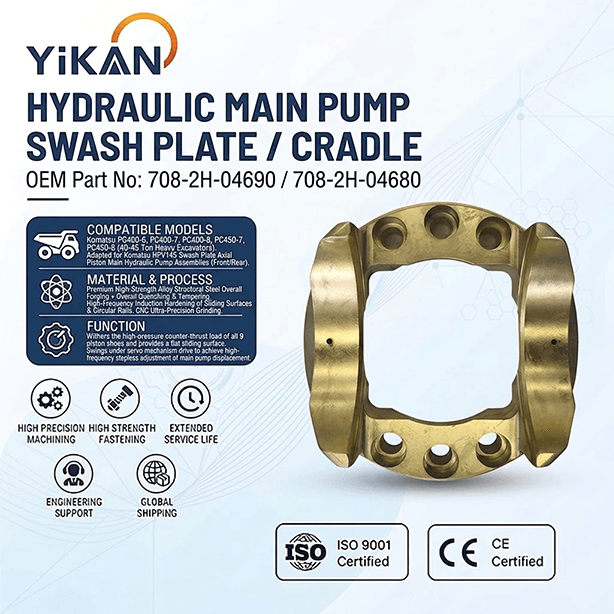
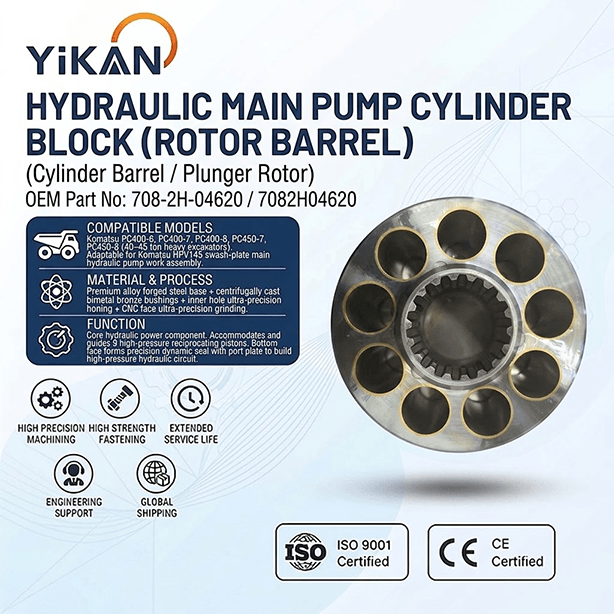
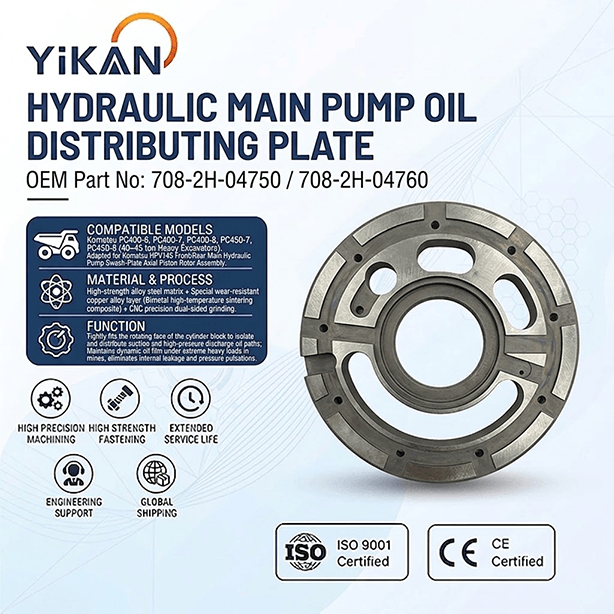
YIKAN KOMSU has long been engaged in the research, development, manufacturing, and global supply of construction machinery hydraulic systems, core engine components, and piping assemblies. Addressing the industry pain points of large tolerance dispersion and substandard materials in aftermarket spare parts for construction machinery, YIKAN KOMSU has established a rigorous full-process quality management system:Incoming raw materials must pass chemical element and metallographic structure analysis by direct-reading spectrometer to ensure that the mechanical strength of pump housings,cylinder blocks, drive shafts, and high-strength fasteners is consistent with OEM technical standards. After core structural parts are machined on high-precision CNC centers, they are uniformly sent to a coordinate measuring machine (CMM) for geometric form and position tolerance inspection, eliminating at the source the risk of assembly clearance deviation caused by out-of-tolerance machining of spare parts.Hydraulic component assembly is completed in temperature-controlled clean workshops. All finished products undergo rated-pressure, internal-leakage, volumetric-efficiency, and continuous-operation durability tests on dedicated test benches before leaving the factory,ensuring that every delivered product matches the host machine mounting ports and technical parameters precisely.
As an important component manufacturer and supplier in the global construction machinery aftermarket, YIKAN KOMSU will participate in bauma China (Shanghai) at booth E2-149. At the exhibition, the company will comprehensively showcase a complete set of aftermarket component solutions for excavators and heavy-duty construction machinery, including high-precision main pumps, main control valve assemblies, high-pressure wear-resistant piping,and reinforced engine-specific components. On-site technical teams will provide customers with physical product displays, tolerance matching consultation, maintenance selection guidance, and global supply-chain docking support.
Frequently Asked Questions (FAQ)
Why must newly purchased qualified spare parts still undergo
technical inspection before installation?
Some spare parts on the market may suffer from aging of rubber seals due to long-term inventory, failure of the anti-rust coating on metal surfaces, or slight impact deformation during transportation. Performing dimensional re-verification and appearance/performance inspection before assembly can effectively avoid equipment rework caused by inherent defects in the spare parts themselves after assembly.
Why cannot ordinary high-strength bolts be used arbitrarily to
replace engine cylinder-head and connecting-rod bolts?
Cylinder-head and connecting-rod bolts are subjected to extremely high alternating tensile and shear loads. Their material elastic limit, thermal expansion coefficient, and thread pitch are all specially calculated. Ordinary bolts have insufficient yield strength and lack anti-loosening self-locking characteristics; they are prone to thermal tensile fracture or loosening,which can cause blown cylinder-head gaskets, cylinder damage, and other major accidents.
What are the consequences of not measuring piston-to-cylinder
liner fit clearance when assembling an engine?
Excessively small clearance will cause the piston to seize and score the cylinder after
thermal expansion; excessively large clearance will allow high-pressure combustion gas to blow-by downward and lubricating oil to be drawn upward, resulting in insufficient engine power, severe oil burning, and abnormal knocking wear. During assembly, specialized measuring tools must be used to verify that the clearance complies with OEM technical specifications.