Nullam dignissim, ante scelerisque the is euismod fermentum odio sem semper the is erat, a feugiat leo urna eget eros. Duis Aenean a imperdiet risus.
Nullam dignissim, ante scelerisque the is euismod fermentum odio sem semper the is erat, a feugiat leo urna eget eros. Duis Aenean a imperdiet risus.
 author
What are the consequences of installing the wrong parts
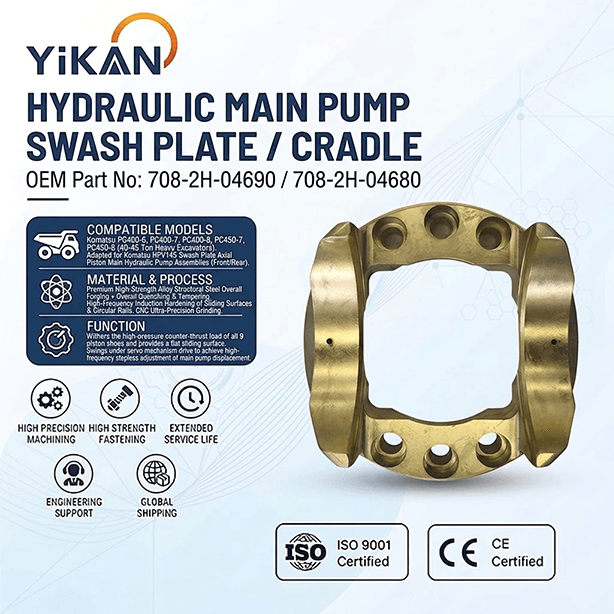
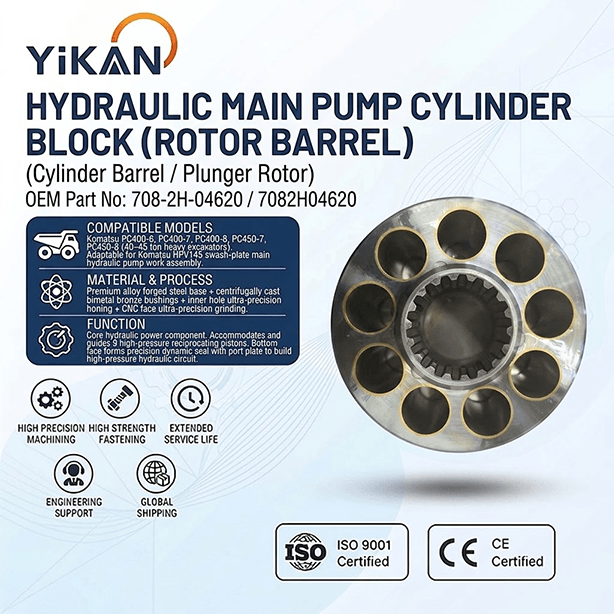
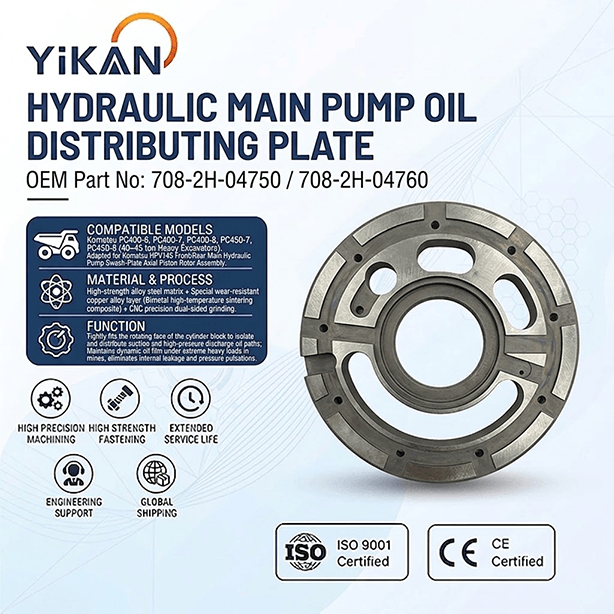
What problem that purchase excavator parts often happened, is not buy a overprice part,but buy a part looks the same.Many buyers merely consider that whether the holes can fit properly, the splines can mesh, and the flanges can be tightened. However, the real issue lies in whether the engine number’s displacement, rotation direction, internal settings and control logic are all compatible.
Appearance only solves the installation problem it does not solve the system problem.When the part numbers do not correspond,the consequences range from abnormal response and rising oil temperature to metal debris circulating through the entire machine,a scrapped main control valve or even a safety incident.

Hydraulic systems are sensitive to parameters. Gear pumps, main-pump regulators, may share identical external dimensions, yet the slightest internal difference turns controllable flow and pressure into uncontrolled variables.
For example PC200 series,its correct gear pump is 708-2L-25410 or 704-24-24420; installing 708-2L-25420 or 704-24-26430 instead will still allow the bolts to tighten and the shaft to engage.However, displacement, rotation, or internal adjustment settings have changed.The result is not performance is slightly worse,but insufficient pilot flow leaves the machine weak and slow, while excessive pilot pressure makes the joysticks hypersensitive and impact-prone, accelerating wear on seals and the pilot relief valve.
Main-control-valve spools are even more deceptive. Spools from different circuits can look nearly identical, yet their metering notches, damping orifices, and land dimensions differ. A wrong spool may cause the boom joystick to move the bucket, or eliminate fine control altogether. Worse, excessive clearance produces internal leakage, or thermal expansion locks the spool in the bore and scores the valve body. Once the bore is damaged, a valve assembly worth tens of thousands of dollars must be replaced as a complete unit.
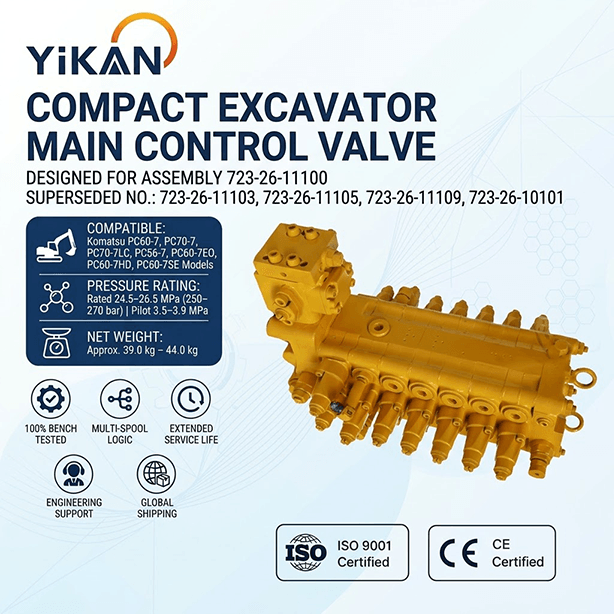
The cost of a mismatched part rarely ends with another tear-down. Losses amplify in successive layers.
Economic cost
Repeated disassembly of precision pumps and valves consumes expensive technician hours. Each major intervention also risks contaminating or discarding hydraulic oil and filters. One rework cycle of a main pump or main control valve frequently costs more in labor and materials than the component itself.
Machine performance
Sluggish, weak, or completely unpredictable response destroys coordinated multi-function capability and cuts daily output sharply. Fine grading, lifting, and work in confined spaces become nearly impossible; the machine shifts from productive to merely operable.
Hardware destruction
This is the most severe cascade. A seized spool that scores the valve bore generates metal particles. Those particles travel with the high-pressure oil and rapidly damage the main pump, swing motor, travel motors, cylinders, and every other precision surface. The entire hydraulic system can be rendered scrap, with repair costs approaching or exceeding the residual value of a used machine.
Safety risk
An excavator weighing tens of tons that suddenly drops a boom, surges uncontrollably, or loses pressure while lifting creates a direct hazard to people and surrounding equipment. When such an incident occurs, contract penalties and liability claims far outweigh the price of any single part.
The common thread is an initial “odd feel.” Continued operation quickly turns a localized problem into a system-wide failure.
Procurement and maintenance managers should ask not only “Will it bolt up?” but “Will it push the system into a second failure?” Before ordering or shipping, at least the following points must be confirmed:
Missing any one of these checks invites a look-alike mismatch. For precision components such as gear pumps and main-control-valve spools, a supplier that offers only “it looks the same” without a documented matching process significantly raises the risk.
YIKAN KOMSU (Guangzhou Yiyan Machinery Equipment Co., Ltd.) has specialized in hydraulic pumps, motors, and construction-machinery components for more than 20 years. The company maintains a database of over 10,000 repair and matching cases, operates a 3,000 m² automated production facility, and achieves CNC machining accuracy of ±0.003 mm. Its products serve customers in more than 100 countries and regions, with a repurchase rate exceeding 90 % and an outgoing quality rate of 99.8 %. A six-month warranty is standard.
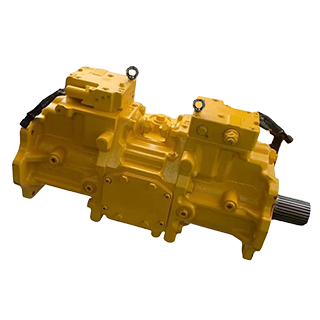
From early sales and repair work the company has developed full in-house capability covering design, precision machining, assembly, testing, and after-sales support. Every hydraulic component undergoes raw-material spectral analysis, post-machining CMM inspection, controlled assembly cleanliness, and final functional testing. For common models such as the PC200-8, PC350-8M0, and PC650-8, gear pumps, main pumps, and valve components can be rapidly matched to original part numbers; sample processing and small-batch customization are also available.
Standardizing the matching verification at the quotation stage is far more valuable than adjusting after the fact. At bauma China 2026, YIKAN KOMSU will exhibit at booth E2-149, presenting aftermarket hydraulic solutions for excavators and heavy equipment. Visitors can discuss component life management under high-frequency heavy-duty conditions, model-specific matching details, and practical experience with system flushing and verification. Customers seeking precise selection guidance will find that starting from the hydraulic-component service portal typically shortens decision time and reduces matching errors and repeat downtime more effectively than a generic inquiry.
Q1: Why can’t two gear pumps that look identical be interchanged if the part numbers differ?
A1: Different part numbers normally indicate differences in displacement, rotation direction, or internal relief settings. Undersized displacement produces insufficient pilot pressure and weak response; oversized displacement produces excessive pressure and sharp impacts. Opposite rotation can instantly rupture the pump housing. None of these differences is visible from the outside.
Q2: What is the most dangerous consequence of installing the wrong main-control-valve spool?
A2: Spool seizure that scores the valve bore generates metal particles that contaminate the entire hydraulic system, destroying the main pump, motors, cylinders, and other components. This is the primary path from a localized fault to total system failure.
Q3: What information must be confirmed before ordering to minimize the risk of a mismatch?
A3: Machine model and serial number, complete original part number, rotation direction, port and flange layout, control type, and current symptoms. The more complete the information, the lower the probability of a matching error.