Nullam dignissim, ante scelerisque the is euismod fermentum odio sem semper the is erat, a feugiat leo urna eget eros. Duis Aenean a imperdiet risus.
Nullam dignissim, ante scelerisque the is euismod fermentum odio sem semper the is erat, a feugiat leo urna eget eros. Duis Aenean a imperdiet risus.
 author

Global carbon reduction regulations rebuild the logic of international competition to construction machinery industry.When Traditional diesel excavator enter markets,is needed internal combustion engine displacement certification.The machine not only need to be equipped with expensive post-treatment system,but also face the challenges of a long certification process and high maintenance costs in the later.Meanwhile,the new energy construction machinery has removed the internal combustion engine to avoid the exhaust regulations review at the source.But new energy excavators can’t immediately replace traditional excavators in all fields.At this stage,the core value of new energy excavator lies in breaking through green barriers and implementing local and precise substitution in specific working conditions that are environmentally sensitive and have abundant power girds.Even if the power source is changed to electric drive,the excavator still requires a traditional hydraulic system,and the coordination between the electric drive and the hydraulic system is necessary.This determines the return on investment for the entire set of equipment.
The constraints of green trade barriers
In mature markets in Europe and America, environmental protection has evolved from a technical initiative to a market access barrier. New energy excavators, with their zero exhaust emissions and low noise characteristics, have directly opened up high-threshold access channels that traditional models could not reach.
Hard mandatory bidding restrictions for zero-emission construction sites: Cities such as Oslo in Norway, Amsterdam in the Netherlands, and Copenhagen in Denmark have fully implemented mandatory zero-emission construction standards in large-scale municipal projects and public infrastructure tenders. Even if traditional fuel-powered excavators are equipped with the highest-level after-treatment systems, they will lose the bidding qualification directly. Pure electric excavators become the only type that can comply with the regulations and enter the market.
Breaking through the strict constraints of equipment noise directives: According to the European Outdoor Equipment Noise Directive, the sound power level during excavator operation is strictly regulated. The operating noise of pure electric excavators is generally 10-15 dB(A) lower than that of diesel engines. They have significant competitive advantages in nighttime operations in urban centers, renovation of old residential areas, and construction in enclosed spaces.
Be cautious of blind substitution
Due to the distribution of power grid facilities and the power consumption reduction caused by high-load operations, pure electric excavators currently cannot achieve a complete replacement in wild areas without power grid support, such as in barren mines or remote infrastructure sites. Their core business profit model is mainly established in the following four scenarios.
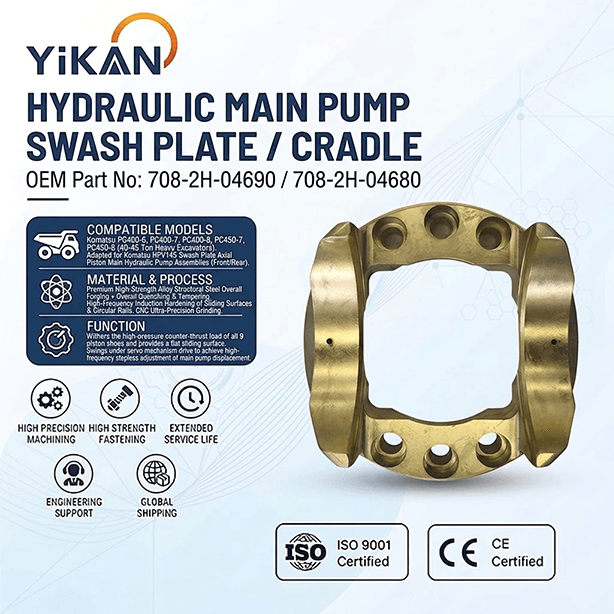
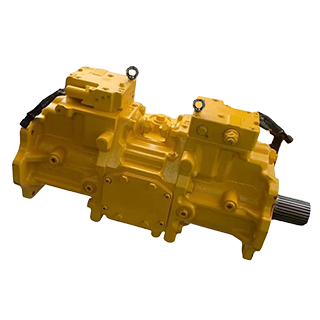
Diesel excavators emit large amounts of carbon monoxide, nitrogen oxides, and particulate matter in narrow and enclosed spaces, which not only threaten the health of workers but also consume a lot of oxygen in the tunnels. To ensure the working environment, construction companies must install high-power ventilation ducts and keep them running for a long time. The electricity cost for ventilation and the maintenance cost of the fans are high. Pure electric excavators, such as Komatsu PC210LCE, are equipped with 708-2G-00320 or 708-2L-00700 hydraulic pumps. They achieve zero exhaust emissions and do not consume oxygen, directly eliminating the expensive investment in auxiliary intake and exhaust systems; at the same time, the electric motor does not need to inhale air for combustion, and there is no power reduction problem of internal combustion engines in long tunnels and high-altitude conditions.
The equipment operation radius in such scenarios is usually fixed within a few hundred meters, and the site has existing and sufficient power grid support. At the same time, the equipment usually operates in shifts, and the electricity cost is lower than that of diesel when operating at high frequency, which can offset the upfront purchase premium of the entire machine.
Daytime construction often faces severe traffic control and road closure pressure, while nighttime construction is severely restricted by environmental protection and noise regulations. The high-frequency roaring of traditional diesel engines is likely to attract complaints from residents and lead to work stoppages. Electric excavators have low noise levels, which meet the strict urban nighttime construction standards, support continuous day and night operations of projects, and can significantly compress municipal construction schedules.
Indoor spaces are narrow and cramped, and exhaust gases cannot diffuse quickly. Traditional diesel micro-excavators cannot enter for operation. The efficiency of manual crushing is extremely low. Pure electric micro-excavators, such as Komatsu PC30MRE-6, are equipped with 708-1S-00150 or 708-3S-11220 hydraulic pumps. They have no exhaust pollution and have a smaller battery capacity, and can be charged with ordinary 220V or 380V power.
Selection of components

To break through the green trade barriers, reliable equipment manufacturing and efficient hydraulic aftermarket suppliers are of great importance.
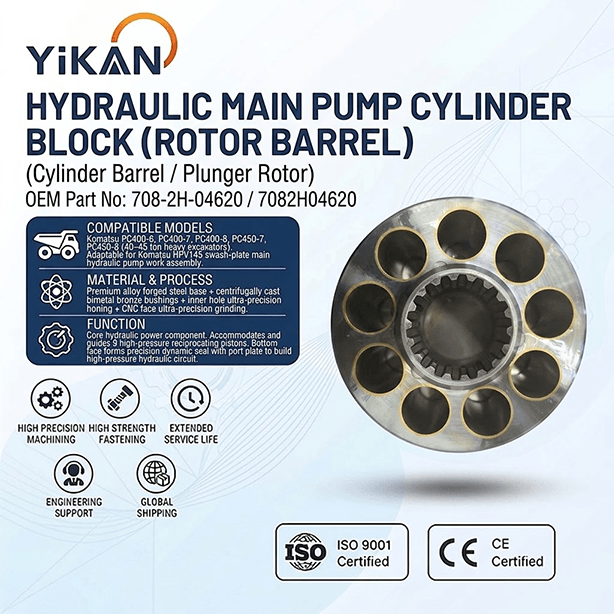
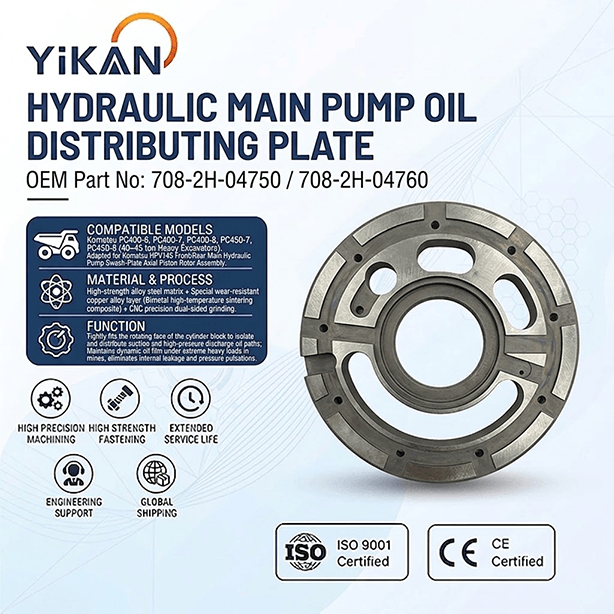
As a professional manufacturer and service provider with over 20 years of experience in the core components of construction machinery hydraulics, Guangzhou YIKAN KOMSU Machinery Co., Ltd. (YIKAN KOMSU) relies on a 3,000-square-meter automated production base to build a one-stop R&D and manufacturing system covering hydraulic pumps, main control valves, and rotary motors. Precision manufacturing and full-process quality control: The workshop is equipped with high-precision CNC equipment, with CNC processing accuracy reaching ±0.003 mm. All raw materials undergo spectral analysis, post-processing is inspected by high-precision coordinate measuring machines, and full-functional bench tests are conducted before leaving the factory, ensuring that the qualification rate of components at the factory reaches 99.8%, and providing a 6-month reliable warranty.
YIKAN KOMSU has over 10,000 actual maintenance and matching case libraries, supporting the rapid locking of suitable solutions based on equipment models and original part numbers (covering main heavy-duty models such as Komatsu PC200-8, PC350-8M0, PC650-8 and their piston pumps and control valve components), effectively eliminating the risk of secondary factory visits due to mismatch between regulators and systems. It also supports sample processing and small-batch customization (OEM/ODM), providing a full-process technical solution for customers facing harsh working conditions and new energy modification requirements, from drawing verification, dedicated valve block integration manufacturing to online testing guidance.
At the upcoming 2026 Shanghai Bauma China (bauma China 2026) exhibition, YIKAN KOMSU will make a grand appearance at this top-level event in the global construction machinery industry. We will fully showcase our core manufacturing capabilities as a professional aftermarket hydraulic component supplier at the E2-149 booth, providing highly competitive replacement solutions for excavators and heavy equipment.
We sincerely invite global construction machinery professionals, purchasing decision-makers, and industry partners to visit and negotiate on-site. Customers can understand and touch these high-standard hydraulic pumps on-site, and discuss with us face-to-face about component lifespan management under high-frequency and heavy-duty working conditions, and the customization of hydraulic components for specific models. YIKAN KOMSU looks forward to collaborating with you at the Bauma exhibition to jointly explore the path to stable operation of equipment assets under the constraints of environmental protection and cost.
FAQ
Q1: Why can’t traditional fuel-powered excavators participate in some municipal projects in Europe despite having the most advanced exhaust after-treatment systems installed?
A: Because some cities in Northern Europe (such as Oslo, Amsterdam, and Copenhagen) have implemented mandatory “zero-emission construction” standards in their municipal tenders. Under such strict requirements, even if traditional fuel-powered excavators are equipped with the most advanced after-treatment systems, they will lose their eligibility to bid outright. Only electric excavators can comply with these standards.
Q2: In deep tunnels and other enclosed spaces, what advantages can new energy excavators bring to the project team that traditional fuel-powered machines cannot match?
A: Firstly, there is a significant cost reduction. New energy excavators have zero exhaust emissions and do not consume oxygen, which can directly eliminate the cost of setting up complex air intake and exhaust systems; Secondly, the electric motor does not need to inhale air for combustion, so in deep tunnels or oxygen-deficient environments, there is no power loss problem that traditional internal combustion engines have.
Q3: How do electric excavators help contractors accelerate project progress in response to the strict outdoor noise regulations in Europe?
A: The noise of electric excavators is generally 10-15 dB(A) lower than that of diesel engines. The electronically controlled operation noise is completely in line with the standards, and the construction team can be approved to carry out construction in old residential areas and at night, thus enabling continuous operation day and night, which greatly speeds up the project progress.