Nullam dignissim, ante scelerisque the is euismod fermentum odio sem semper the is erat, a feugiat leo urna eget eros. Duis Aenean a imperdiet risus.
Nullam dignissim, ante scelerisque the is euismod fermentum odio sem semper the is erat, a feugiat leo urna eget eros. Duis Aenean a imperdiet risus.
 author

A slow excavator invites a fast conclusion: replace the main pump. A slow excavator hydraulics complaint deserves more than a pump guess. The real restriction may sit in a control-valve section, a weak pilot signal, a clogged return path, or oil that changes character once the machine is hot. The complaint has to be narrowed before any high-value part comes off the machine.
The useful question is not whether a hydraulic pump or control valve problem is possible. Both are. The useful question is which test result separates them under the same condition that makes the operator complain. A slow boom by itself tells a different story from an excavator whose boom, arm, bucket, swing, and travel all lose pace together.
Ask the operator to describe the failure in a repeatable way. Is the machine slow from the first start of the day, only after an hour of work, or only when the attachment meets a load? Does the engine hold the rated speed? Does the swing stay normal while the front attachment lags? These details beat a broad report that hydraulics feel weak.
When most functions are slow, attention often moves toward pump output, pump control, engine speed, pilot supply, inlet restriction, or oil condition. A worn main pump can lose useful flow as internal clearance opens up, and a regulator or control piston can leave the pump at too little displacement. Still, a machine-wide complaint does not clear the main control valve. A shared pilot fault, a relief problem, or contamination that affects several valve sections can create a similar feel.
A single slow boom, arm, bucket, travel side, or swing function makes a local path more likely. Check the actuator, lines, port relief, load-holding parts, and matching valve spool before blaming the pump. That is especially true when other functions stay crisp at the same speed and temperature. A dragging spool or internal section leakage can steal performance without slowing the whole excavator.
Before gauge work, inspect oil level, oil appearance, filter service history, breather condition, suction hose condition, visible leaks, and the return circuit. A collapsed inlet hose or a restricted filter can mimic a pump problem. So can aerated oil. If the oil is foamy, unusually dark, or carries metal, replacing a pump or valve without correcting the source risks a second failure.
Compare cold and hot behavior. Cold oil can hide internal leakage because it is thicker. A machine that fades after warm-up points toward leakage, worn rotating parts, a valve clearance issue, or a control fault affected by heat. It does not prove the failed part, but it gives the test sequence direction.
Use the same attachment, load, engine speed, and oil temperature for comparison. A no-load yard cycle is not enough when the complaint appears during trenching or truck loading. Record the function and whether another function is operated at the same time. Combined-function behavior matters because pump flow and valve priority are working together.
A hydraulic pump flow test should be read alongside pressure, oil temperature, and engine speed. Pressure alone cannot show whether the pump supplies enough volume. A pump may build pressure briefly while still losing flow under demand. Weak digging force can also come from a relief or valve leakage path when the pump has usable flow.
Use the test ports and limits specified for the exact machine model. Generic pressure numbers are not a substitute for the service specification, and an incorrect test connection can give a misleading result. Compare main relief behavior, pump outlet performance, case-drain condition where the design allows it, and regulator response. If pump output drops as the oil warms across several functions, the pump and its control circuit deserve closer inspection.
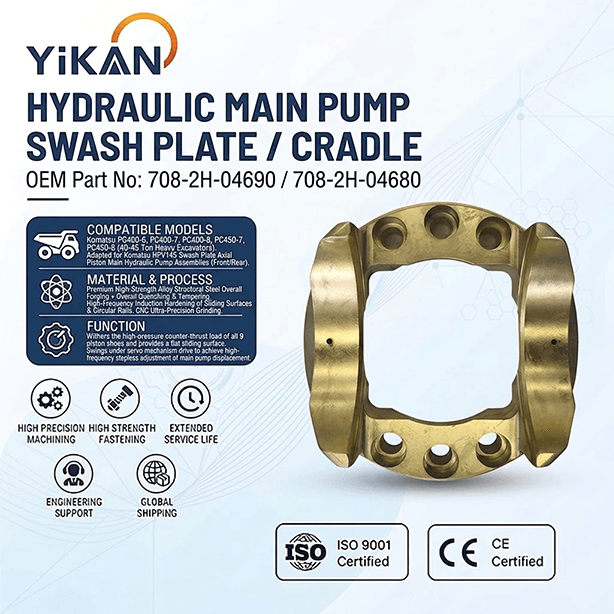
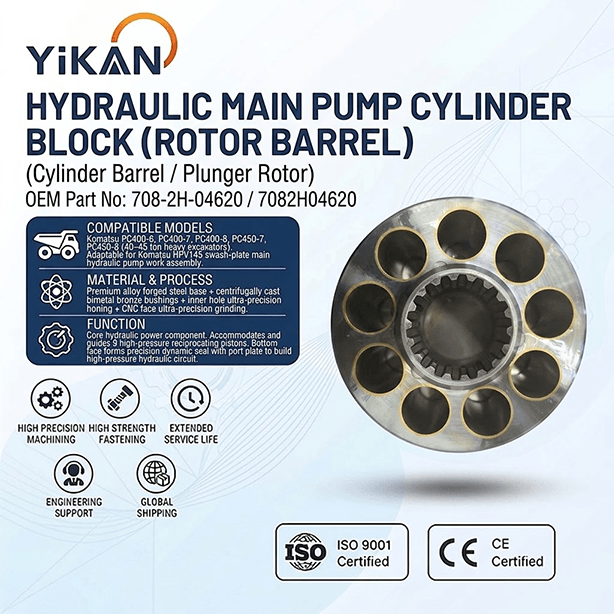
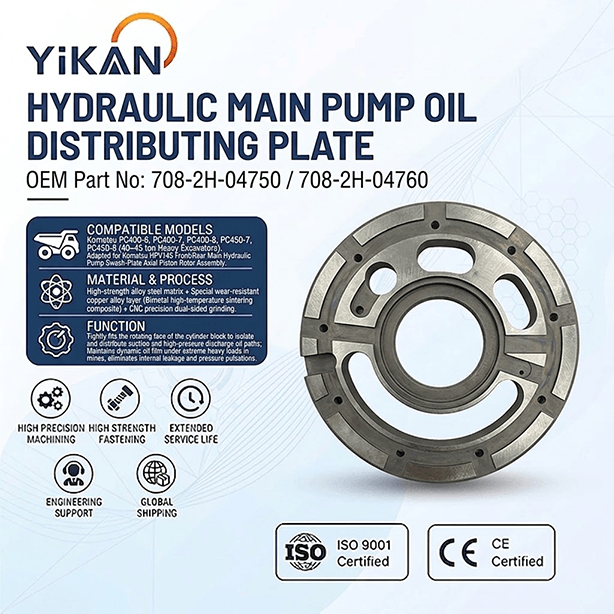
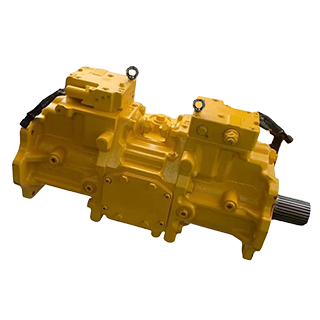
Variable-displacement pumps do not act alone. The regulator, control piston, solenoid or proportional command, and pilot signals can keep a sound rotating group from stroking properly. The Komatsu product has PC130-7 plunger main pump references 708-1L-00650 and 708-1L-00651, with related fitment across PC120-6, PC130-7K, and PC160-7 applications. Verify the original part number and control arrangement, not only the housing shape. A matching PC130-7 hydraulic pump should follow that check. Control valves also include the following types: PC120-6, WA150, WA430-6, WA600, WA470-6, D155AX-6, WB97S-5EO, D61EX-12, PC30Mr-2, and PC27MR-8.

If pump supply appears stable but one circuit remains slow, test the control side. Start with pilot pressure at the relevant command path, then inspect whether the spool receives and returns its control signal cleanly. A pilot issue can make a healthy main valve look faulty because the spool never reaches the position needed to pass flow.
Contamination changes the picture. Fine debris can slow a spool; larger particles can score a bore or hold a relief element open. Internal leakage across a worn section can send oil away from the actuator while the lever feels normal. Compare the affected function with a known-good one, then isolate the valve section using the machine’s service procedure instead of removing the complete valve block on suspicion.
Komatsu has PC160-7 main control valve references 723-57-16400, 723-57-16401, and 723-57-16100. It also has PC130-7 references 723-57-11700, 723-57-11800, and 723-57-11801. Serial range, part number, port layout, spool configuration, attachment circuits, and pilot arrangement all need checking. The PC160-7 main control valve is a useful example of the kind of fitment information a buyer should line up before ordering.
The split is rarely as neat as ‘all slow means pump’ and ‘one slow means valve.’ A two-pump excavator can show a limited group of slow functions when one pump circuit is weak. A sticky merge or priority section can make several motions sluggish. This is the practical split in an excavator hydraulic diagnosis: main pump vs control valve. A sensible excavator hydraulic diagnosis follows the oil path: inlet and oil condition, pump supply, pilot command, valve section, actuator, and then return path.
A pump replacement becomes more defensible when several functions lose speed, output falls in the documented test condition, the regulator has been checked, and contamination or inlet problems have been addressed. A valve repair or replacement becomes more defensible when the loss stays with one circuit, pump supply remains credible, pilot pressure is present, and section-level leakage or spool movement points to the valve.
For an excavator function slow complaint, a quotation should include the machine model, serial range, original part number, symptoms, oil condition, and test observations. This is more useful than simply asking for a valve or pump quote. YIKAN KOMSU supports hydraulic pumps, control valves, valve blocks, parts processing, and system assembly work. It has multi-spool flow and pressure bench testing before dispatch, plus system work covering component selection, valve-block design, piping, assembly, and testing. YIKAN KOMSU supplies non-OEM hydraulic replacement parts compatible with Komatsu equipment, manufactured to meet aftermarket maintenance requirements.
For buyers comparing a replacement, the main control valve and hydraulic pump help separate valve and pump families before fitment is confirmed. The company also reports more than 20 years of hydraulic maintenance experience, over 10,000 repair cases, a 3,000-square-meter automated factory, and CNC machining precision around +/-0.003 mm. These capabilities matter when a repair needs inspection, machining, or a configuration review.
For non-standard repairs, damaged valve blocks, or parts that need a drawing and sample review, the hydraulic component processing service is more appropriate than treating every slow excavator hydraulic fault as a catalog purchase. A buyer can also begin with YIKAN KOMSU and send the machine data and test record to the sales team for fitment review. This is the practical way to settle a hydraulic pump or control valve problem before a purchase order is issued. That discipline is central to slow excavator hydraulics work.
Q1: Can an ‘excavator function slow’ complaint come from a bad main control valve?
A1: It can, particularly when a shared pilot, relief, merge, or priority path is involved. However, all-function slowness also calls for pump supply, engine speed, inlet restriction, oil condition, and heat-related checks before a valve is condemned.
Q2: What is the clearest sign of a main pump vs control valve problem?
A2: The clearest sign comes from a repeatable test pattern, not from one symptom. Broad low flow across several functions under the same condition points toward supply or pump control. A loss tied to one function after pilot checks points more strongly toward that valve section or actuator circuit.
Q3: Should an excavator main control valve be replaced before pressure testing?
A3: No. Pressure, flow, pilot, temperature, and oil-condition checks should come first and should follow the machine-specific service procedure. A valve is costly and fitment-sensitive, so the test record should support the replacement decision.