Nullam dignissim, ante scelerisque the is euismod fermentum odio sem semper the is erat, a feugiat leo urna eget eros. Duis Aenean a imperdiet risus.
Nullam dignissim, ante scelerisque the is euismod fermentum odio sem semper the is erat, a feugiat leo urna eget eros. Duis Aenean a imperdiet risus.
 author
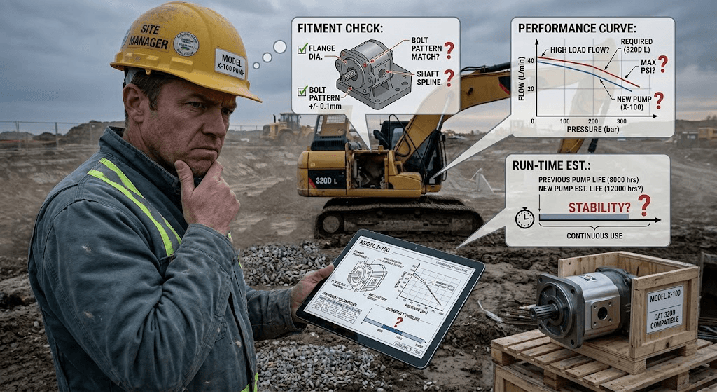
After the equiment stopped running due to malfunction of the hydraulic pump,The first question to manager not whether the parts are original,but is it compatible?Its performance is insufficient?How long will it be able to operate?Aftermaket pumps face trust barrier for a long time.The source is not related to price that is cheaper than the original factory,but in the lack of verifiable evidence across these three areas.
When the compatibility confirmation is not clear,the test data is incomplete,and the service life can only be estimated by intuition,customers naturall tend to choose the OEM,even if the delivery time is longer and the cost is higher.Conversely,if the aftermaket suppliers can make these three points into verifiable,trust will shift from cheap alternatives to risk-controlled choices.
The following breaks down the decision logic that genuinely reduces the risk of secondary failures, focusing on three entry points: fitment accuracy, performance compliance, and post-replacement service life.
Accurate Fitment:Installation Compatibility Is the Star Point
For the purchasers,similarity in appearance does not necessarily mean interchangeability.During the purchasing process,you may notice that common models such as the PC200-8 hydraulic pump(part number 708-2L-00490)may have very similar installation flanges and oil port layouts to the PC350-8M0.However,purchasers must be vigilant about the differences in rotation direction and control valve type.These differences can cause the new pump to fail to work properly after installation, or result in serious faults such as overheating, internal leakage, and abnormal operation after short-term operation.
o ensure that the accessories provided by the supplier are fully compatible with your equipment, the purchaser must actively request the supplier to verify the following core list during the purchase process:
Equipment model and serial number: This is the basis for confirming the match.
Original pump part number: Ensure the correspondence between the replacement part and the original factory code.
Rotation direction: Strictly confirm the rotation direction to prevent damage to the system after installation.
Oil port position and installation flange: Verify whether the physical connection dimensions are consistent.
Control type and adjustment characteristics: Ensure the matching of the hydraulic regulator and the electrical control signal.
The purchaser should note that the absence of confirmation for any of the above items may turn the expected “quick resumption of production” into a painful “second factory visit”. During the quotation stage, you should request the supplier to make the compatibility verification a standardized process and provide you with clear compatibility confirmation results. This is far more valuable than believing the supplier’s later statement of “make some adjustments later”. Only when the purchaser controls this first threshold can the subsequent installation stability and service life truly be meaningful.
The Test Data Matters More Than Appearance
“Looking the same” does not solve real operating conditions. Flow stability, volumetric efficiency at rated pressure, case drain volume, noise, and temperature rise are the hard metrics that determine whether a pump can carry the load.
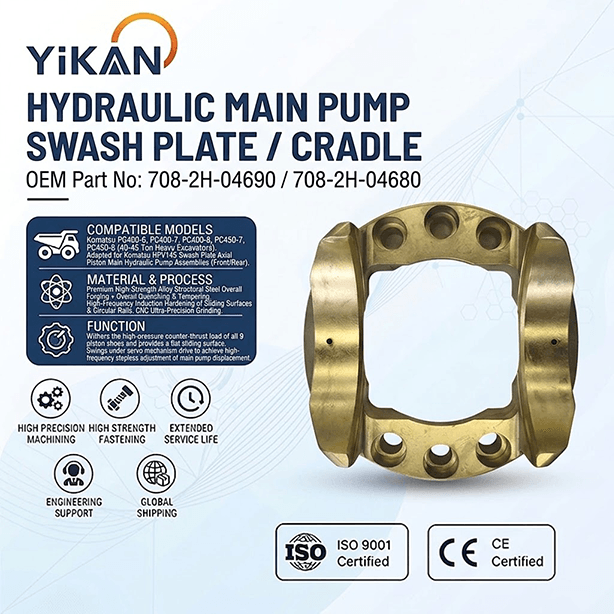
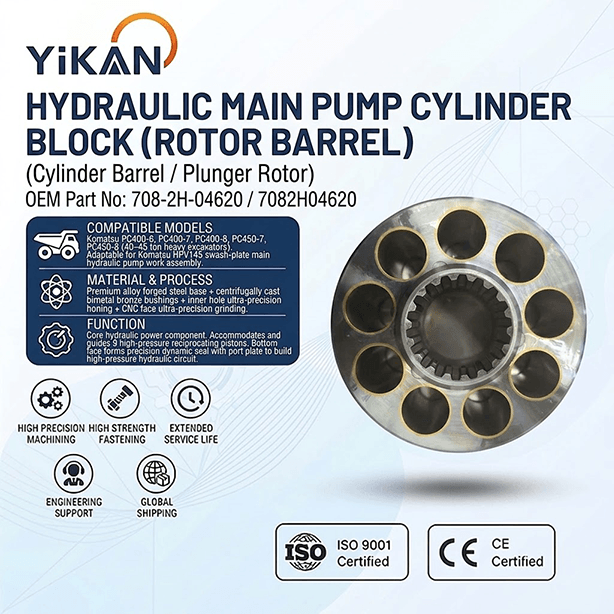
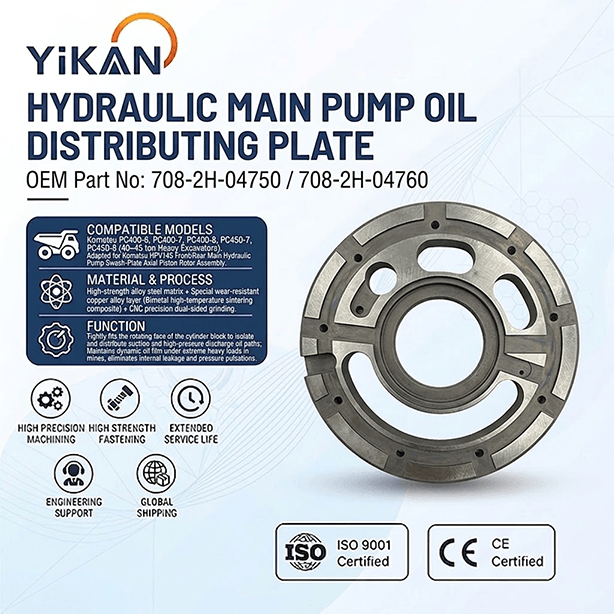
A eligible aftermarket hydraulic pump must undergo complete inspection:dimensional checks and critical-component wear-limit evaluation, precision surface treatment, and pre-shipment test-stand validation. Bearings, valve plates, piston-slipper assemblies, swash plates, port plates, and regulators should all be processed and verified against standards—not merely cosmetically refurbished.
A “cheap pump” without flow curves, volumetric efficiency figures, or case drain data often simply postpones the next failure. Performance compliance means the pump delivers stable flow and pressure under real working conditions—not that it merely “turns.”
Only when the aftermarket pumps can provide test results that can be compared with those of the original factory products will the price advantage truly translate into a cost advantage, rather than a risk transfer.
Post-Replacement Service Life: Predictability Is the Real Value

The problem about how long can this pump operate stably after being installed is considered by customer.
Service life is never determined by a single component.It is combined result of fitment accuracy,performanced compliance,and system cleanliness. After a pump failure, the hydraulic system is often already contaminated. If metal debris, oxidized oil, and residual contaminants are not thoroughly removed, even the best new pump will wear rapidly. When housing cracks, severe scoring, or repeated metal debris appear, a system-level assessment is required—not just a simple pump replacement.
A quality aftermarket solution should provide:
1.Clear fitment and test documentation
2.System flushing and filter-element replacement recommendations
3.Reasonable warranty commitment
4.Responsive after-sales technical support
Only when “service life” is converted from a vague expectation into a manageable risk will customers willingly choose aftermarket pumps. A pump that solves the problem in one intervention and returns the machine stably to the job site—even at a modestly higher unit price—usually delivers a lower total invoice once freight, labor, oil, flushing, and production loss are all counted. Repeat downtime is the real cost killer.
Supplier Capabilities That Truly Reduce Repeat Downtime
YIKAN KOMSU (Guangzhou Yikan Machinery Equipment Co., Ltd.) is a manufacturer and repair service provider specializing in hydraulic pumps, motors, and construction machinery components. The company has more than 20 years of deep expertise in hydraulic repair and construction machinery parts, maintains a database of over 10,000 repair and matching cases, operates a 3,000 m² automated production base, and possesses high-precision CNC machining capability of ±0.003 mm. Products serve customers in more than 100 countries and regions worldwide, with a repurchase rate exceeding 90% and an outgoing quality rate of 99.8%.
From early sales and repair operations, through focused remanufacturing of core hydraulic components, to the establishment of an independent R&D center and production base, YIKAN KOMSU has built a complete capability chain covering design and development, precision machining, assembly and testing, and after-sales support. In addition to factory-direct supply, the company supports sample machining, small-batch customization, and online after-sales technical guidance. All hydraulic components undergo full-process quality control: raw-material spectral analysis, post-CNC coordinate measuring machine (CMM) inspection, assembly cleanliness control, and final functional testing, backed by a 6-month warranty.
When purchasing a replacement pump, the decisive factors are never marketing language, but rigorous fitment verification, and a responsible commitment to post-replacement service life. A pump that is not correctly matched to the machine—no matter how polished the packaging—will ultimately become the customer’s next downtime event. As a manufacturer focused on Komatsu and other construction machinery hydraulic components, YIKAN KOMSU continuously develops aftermarket solutions for pumps, motors, valves, and related assemblies, and cordially invites customers to visit booth E2-149 at bauma China 2026 to experience Chinese-manufactured hydraulic replacement solutions in person.
For customers who need clear selection guidance, starting from the Hydraulic Components Service portal shortens decision time more effectively than sending a generic inquiry. Product pages help progressively lock the actual model from pump series and determine whether OEM, remanufactured, or quality aftermarket solutions best suit the current equipment. This approach may appear to take one extra step, yet it significantly reduces matching errors and repeat downtime over the long term. For related content, continue reading the Smart Buyer’s Guide to Hydraulic Motor Selection.
Frequently Asked Questions
Q1: What information is typically required for aftermarket pump fitment confirmation?
A1: Machine model and serial number, original pump part number, direction of rotation, port layout, mounting flange, control type, and current failure symptoms. The more complete the information, the lower the risk of mismatch and the shorter the time to restore the machine to operation.
Q2: How can one judge whether performance truly meets the standard?
A2: Focus on whether bench-test data is provided (flow curves, volumetric efficiency, case drain volume, noise and temperature rise) and whether the supplier has precision machining and inspection capability to support the claims. Suppliers offering only low prices without test and matching safeguards carry higher risk. Suppliers with more than 20 years of industry experience, real factory capacity, high-precision machining capability, and high repurchase rates are generally more trustworthy.
Q3: Which factors most strongly influence post-replacement service life?
A3: Fitment accuracy, outgoing performance data, and system cleanliness. If the system is not flushed and filters and oil are not replaced after a pump failure, the life of the new pump will be significantly shortened. A supplier that also provides cleaning recommendations and warranty support is better positioned to protect actual service life.
Q4: How does YIKAN KOMSU implement its warranty and quality control?
A4: All hydraulic components undergo raw-material spectral analysis, post-CNC CMM inspection, assembly cleanliness control, and final functional testing. The outgoing quality rate reaches 99.8%, and a 6-month warranty is provided (covering performance failures not caused by human factors). Online after-sales technical guidance is also available for rapid response to application issues.
Q5: Under what circumstances is it still advisable to prioritize OEM pumps?
A5: When the old pump has severe structural damage, the system is heavily contaminated, the machine is under warranty, or the OEM has explicit traceability requirements—and lead time is acceptable—the OEM solution is usually more prudent. When the cost of a secondary failure clearly exceeds the price difference, OEM should also be prioritized in the evaluation.
From accurate fitment and performance compliance to post-replacement service life, trust in aftermarket pumps is built on verifiable processes and data—not on price comparison alone. When these three points are genuinely implemented, customers no longer see a “substitute”; they see a solution that can more quickly break the downtime chain and return the machine stably to the production site.
封面图-ps压缩版、.png)