Nullam dignissim, ante scelerisque the is euismod fermentum odio sem semper the is erat, a feugiat leo urna eget eros. Duis Aenean a imperdiet risus.
Nullam dignissim, ante scelerisque the is euismod fermentum odio sem semper the is erat, a feugiat leo urna eget eros. Duis Aenean a imperdiet risus.
 author
Under what circumstances are aftermarket parts better than OEM

As everyone knows,original parts represent quality and reliability.Most equipment manager use the original parts as the first choice usually,consider that OEM can ensure the equipment run stably and can reduce the risk of malfunction.However,reality is much more complicated than we imagine.When your equipment enters a specific service stage,the project faces strict time constraint,or the fleet in the transitional period between short-term rental and disposal of assets.Under these situation,continuing to use original parts is not the best solution.Instead,it my cause some problems like excessive capital occupation,marginal benefit decreases,affecting the whole project profit.
Aftermarket parts are not merely low-cost substitutes,but they are a choice that,under specific conditions,can achieve a more reasonable balance among performance,cost,and timeliness.
Rational calculation of marginal cost and overall residual value of the machine
The hydraulic pump as the core power component of the excavator,is designed to have a service life about 10000 working hours.For example PC200-8(pump part number 708-2L-00490),PC400-8(pump part number 708-2H-00026),based on the assumption that the operation lasts for approximately 24 hours every day, this lifespan is approximately equal to 416 working days.When service time of the entire machine exceeds this time,the equipment will enter a stage of high depreciation and high failure risk.At this point, if we continue to use high-priced original pumps, the marginal cost effect will quickly become apparent.
We can analyse the depreciation and residual value by formula.
Assume the purchase price of the excavator is P(100,000).The estimated scarp value is 8% of the initial purchase price,and the designed operational life is 10,000 hours.Then,the hourly depreciation amount=(100000-0.08×10000)÷10000=9.92
Residual value = P- (Hourly depreciation amount×Actual working hours).
When the machine has been in operation for more than 10,000 hours,the overall residual value of the machine has significantly decrease,so the cost of replacing a set of original pumps often easily exceeds 40% of the current residual value of the machine.Replacing the original pump not only fails to be fully recovered within the limited subsequent operating time, but also accelerates the aging of other worn components,causing the new pump to experience premature performance degradation. As a result, the original pump’s theoretically high lifespan cannot be fully realized, significantly reducing its actual cost-effectiveness.
From a cost perspective, equipping equipment that has exceeded its design life with a original pump is equivalent to making a high-value investment on a highly depreciated asset.This is classic example of a decision involving diminishing marginal benefit. In such cases, a better solution would be to select high-quality aftermarket parts that match the required performance specifications and are more more cost-effective, based on the equipment’s remaining service life expectancy.
Aftermarket parts are more cost-effective in these cases
Short-term rush work, extremely high time cost, tight schedule, and high pressure from penalty fees.
During construction projects, delays in the schedule often result in hefty penalty fees and cascading losses. Original factory parts usually have longer ordering and logistics cycles, and their prices are relatively higher. While high-quality aftermarket parts can achieve faster delivery through more flexible supply channels, they can significantly shorten downtime. In scenarios where “time cost is much higher than the price difference of spare parts”, the value of being able to immediately resume operations far exceeds the potential gains from the theoretical lifespan difference. Under cash flow pressure, exchanging lower upfront investment for schedule guarantee and risk avoidance of penalty fees is a more commercially rational choice.
Transition period for short-term leasing of fleets or preparing for resale (within half a year or one year).
When equipment is in short-term leasing, project temporary allocation, or planned for resale within half a year to one year, continuing to configure original factory pumps is an excessive investment. After the equipment stops operating, the remaining lifespan is difficult to convert into actual benefits, and instead increases the sunk cost during asset disposal.
Taking the main pump of a common medium-sized excavator as an example for comparison:PC200-8 (pump part number 708-2L-00490) original factory price is approximately 32,000 – 42,000 yuan, and aftermarket price is approximately 12,000 – 20,000.PC210-8K (pump part number 708-2L-00701) original factory price is approximately 40,000 – 55,000 yuan; aftermarket part is approximately 18,000 – 28,000.
The designed lifespan of the original factory pump is approximately 10,000 hours, with higher procurement costs. High-quality aftermarket pumps, under strict quality control , typically have an actual usable lifespan of about 70% – 80% (approximately 7,000 – 8,000 hours) of the original factory’s lifespan. Calculated based on an actual operation intensity of about 2,000 – 2,500 hours per half year and 4,000 – 5,000 hours per year, high-quality aftermarket pumps can fully meet the demand during the transition period. The operational value generated during the service period is basically the same, but the initial cash outflow is significantly lower, with less capital occupation, and there is no need to pay for the “excess lifespan” when reselling. The fast supply time and short-term high cost performance are the core advantages of aftermarket parts in such scenarios.
Aftermarket parts also have difference
The quality of aftermarket parts varies greatly in the market. Low-end products have significant differences in key aspects such as material purity, heat treatment processes, and sealing component precision, which may lead to reduced volumetric efficiency, insufficient thermal balance capacity, and increased early wear. Therefore, aftermarket parts cannot be generalized.
The truly high-quality aftermarket parts, by conducting strict factory tests and batch application validations, can achieve a comprehensive performance of 70%–80% of the original factory’s level. They demonstrate reliability in key indicators such as pressure stability, response speed, thermal balance capacity, and practical operational reliability, which is sufficient to support normal and even higher-intensity continuous operations. The key to selection lies not in the lowest price, but in whether complete test data, quality assurance commitments, and scenario adaptation validations are available.
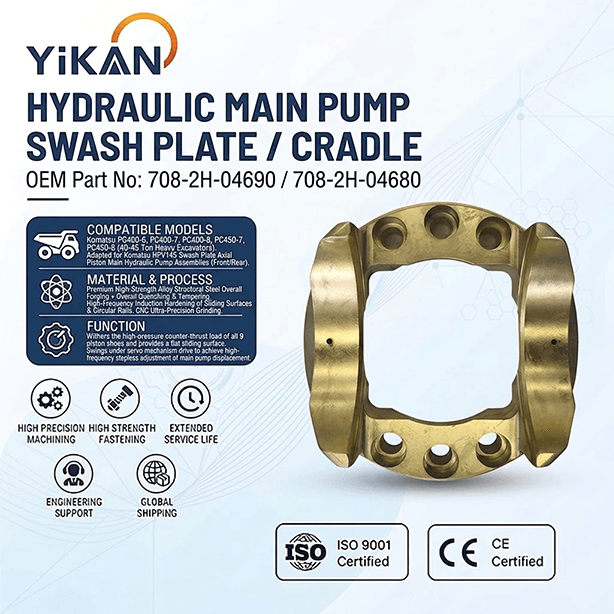
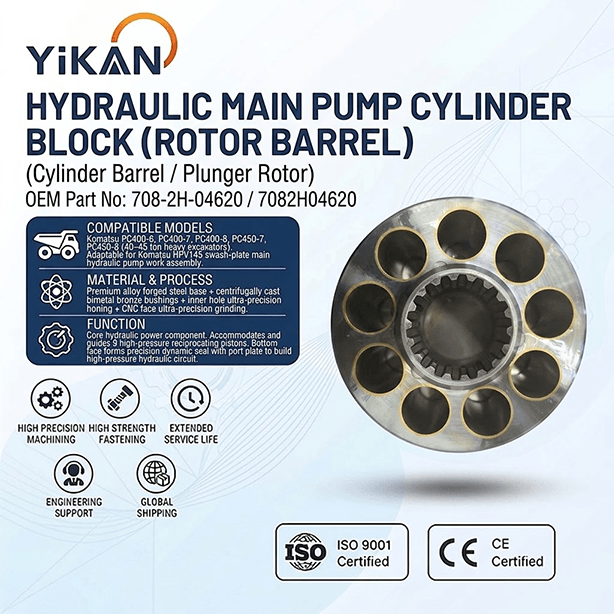
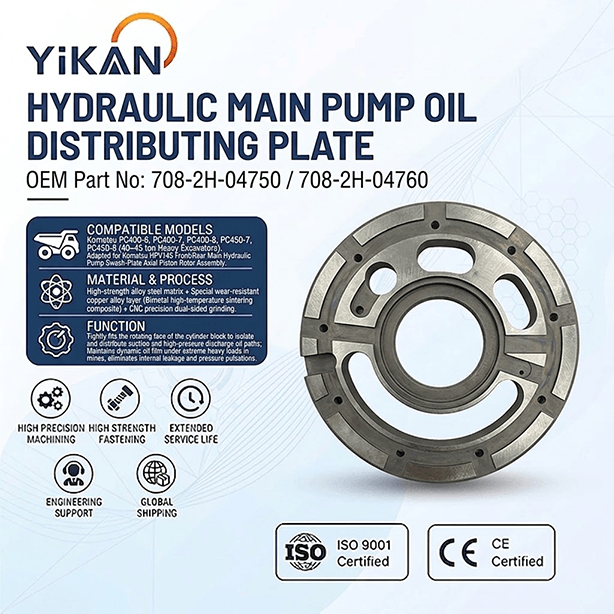
In this field, YIKAN KOMSU is a typical representative of high-quality aftermarket parts. The company has been deeply involved in the hydraulic field for over 20 years, with an R&D and production team, a 3,000㎡ automated factory, focusing on the independent design and manufacturing of key components such as hydraulic pumps, fan pumps, working pumps, rotary pumps, and control valves. Its products are widely used in excavators, loaders, bulldozers, and mining vehicles. Relying on factory direct sales, OEM/ODM capabilities, raw material spectral analysis, CNC machining accuracy of 0.003mm, and an 99.8% factory pass rate, its products, under strict quality control and process benchmarking, have a stable comprehensive performance reaching 70%–80% of the original factory level, and are equipped with a 6-month warranty, truly achieving performance matching, cost controllability, and flexible supply. Whether it is for short-term rush work, equipment transition periods, or maintenance of machines that have exceeded their design lifespan, choosing a high-quality aftermarket brand like YIKAN KOMSU that has been verified by the market (with over 5,000 service repair shops and equipment suppliers, and a repeat purchase rate of over 85%–90%) can achieve the optimal balance between marginal cost and actual value.
FAQ
Q1: How can one quickly determine if a device is suitable for replacing with a high-quality aftermarket pump?
Whether the total operating hours of the entire machine have significantly exceeded 10,000 hours, whether the estimated remaining service life is within one year, and whether the combined loss of one day of downtime is much higher than the price difference of the spare parts. Meeting any of these two conditions, high-quality aftermarket parts are usually a more rational choice.
Q2: When choosing YIKAN KOMSU type aftermarket parts, what are the most important on-site guarantees to focus on?
Whether it provides real factory test data and quality assurance commitment, and whether it supports quick matching by model/Original Equipment Manufacturer part number and gives compatibility confirmation. These are more capable of avoiding risks in the later stage than simply comparing prices.
Q3: When conducting batch purchases or urgent small orders, what additional support can YIKAN KOMSU provide?
Support for small batch trial orders for verification before stable large-scale supply, while having OEM/ODM customization capabilities, and being able to prioritize production and shipment for urgent demands to help users further compress the supply cycle and capital occupation while ensuring performance compatibility.